Saturday, November 16, 2013

Yearnings

The cure for pain is in the pain.
Good and bad are mixed. If you don't have both,
you don't belong with us. - See more at: http://allspirit.co.uk/rumilovers.html#sthash.DLUmUn3q.dpuf
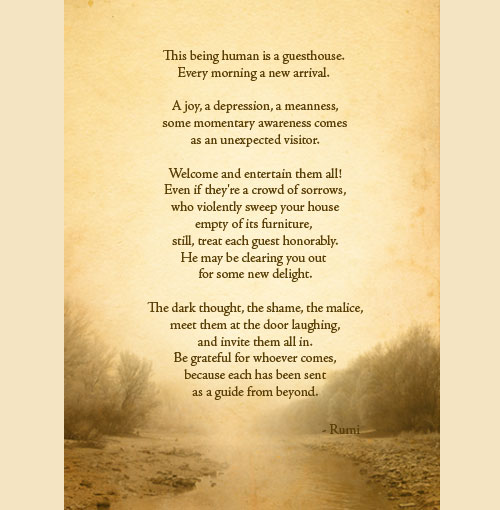
The cure for pain is in the pain.
Good and bad are mixed. If you don't have both,
you don't belong with us. - See more at: http://allspirit.co.uk/rumilovers.html#sthash.DLUmUn3q.dpuf
The cure for pain is in the pain.
Good and bad are mixed. If you don't have both,
you don't belong with us. - See more at: http://allspirit.co.uk/rumilovers.html#sthash.DLUmUn3q.dpuf
The cure for pain is in the pain.
Good and bad are mixed. If you don't have both,
you don't belong with us. - See more at: http://allspirit.co.uk/rumilovers.html#sthash.DLUmUn3q.dpuf

I think people in general have a tendency to overlook their own emotions.  Either you dislike what you're feeling, so you try to distance yourself from it; or you feel too busy to deal with it; or you can't make sense out of it, so you try to tell yourself, "There's no reason for me to feel that way."  But I disagree.  There is always a reason for every feeling, even if that reason is subconscious.  However, whether or not you understand the origin or reason behind every feeling doesn't entirely matter.  One of the fundamentals of Rumi's philosophy is that all human emotion serves a purpose.  Feelings are neither arbitrary nor meaningless.  Every yearning, every desire you have exists so that you will seek out the things you really need--not only to live, but also to be a complete human being.  We feel hunger so that we will eat.  We feel tired so that we will sleep.  We yearn to be creative and express ourselves because we need to create things.  We yearn for God, for a higher spiritual order, because we need to make spiritual sense of our universe.  It is not enough to just exist.  We must know why.  We must feel there is a purpose to our being.  

I'm not saying that simply wanting there to be a God is a justification for believing in God.  I think Rumi's idea is that, if there is a yearning, there must be an answer to that yearning.  If we are thirsty, we must drink.  No one would deny this.  But does it not logically follow then, that if someone deeply longs to make music, they must make music?  Why is it that so many famous artists throughout history have been destitute, starving, cast out of society, and yet somehow felt overwhelmingly compelled, not to seek out a decent paying job, but rather to make art?  As Vincent van Gogh said in a letter to his brother, "Sometimes I draw . . . almost against my will, but it is a hard and difficult struggle to draw well."  Why on earth would he choose to spend his time doing such a seemingly fruitless activity, when he lived in extreme poverty and only sold one painting in his entire lifetime?  Because he had a hunger that needed to be fed: a hunger as real and demanding to him as any physical hunger.  

This is where it gets difficult, I think.  Everyone understands hunger, thirst, and tiredness because we all feel it in essentially the same way.  But not everyone feels the need to draw, or play sports, or commune with God.  Some people feel these yearnings so powerfully that it drives their entire lives, while others might feel that same yearning not at all.  Still more people might feel a moderate amount of this or that desire, but not to the point where they would make such sacrifices as van Gogh did.  When it comes to non-physical needs, it takes a great deal of empathy and patience to understand what drives people to do what they do.  However, like Rumi, I believe that nothing we feel is without significance.  Although making music, writing a story, or playing a sport might not be essential to life in the physical sense, it is essential in the spiritual sense.  It is not water for our bodies, but for our souls.  Whatever you do that makes you feel most truly happy and whole, that is your purpose in life.  The trick is that it's up to you to find the right balance of these things in your life, and to be strong enough to insist on the things you need, even if other people don't understand them.    

Of course, then you must ask, what if you yearn to do something wrong?  What if the fruition of your desire would be harmful to other people, or even to yourself?  Obviously you can't just use the excuse that you wanted to do it, so therefore it must be right.  Our feelings and our desires need to be interpreted, balanced, and acted upon in a constructive way.  An emotion may be leading you towards the right place, but you must interpret it correctly and find the right way to get there.  Not all pathways to an objective are equal.  For example, if you feel that a situation in your life is getting alarmingly out of control, perhaps your first impulse would be take control of it through violence or intimidation.  That impulse is not the feeling you should follow.  What you really need to ask yourself is, what is upsetting to me about this situation and how can I fix it in the most effective, benevolent way possible?  Violence just leads to more violence, and running away from the situation just leaves it to be solved another day.  But if it's upsetting to you, that means it needs to change, and there is probably a decent way to fix if you just think about it.  I'm not saying that making that change is always easy, or that you can always do it without upsetting anybody, but most of the time, there is probably a constructive path that will lead you to what you really need.

Life hurts sometimes, but that pain only exists to tell us what we need.  Rumi said, "The cure for pain is in the pain."  It is a guide sent to lead you towards goodness and happiness.  Even if you are lonely or feel unfulfilled, don't run away from that feeling.  Don't ignore it.  Follow it. 

"That hurt we embrace becomes joy.  Call it to your arms where it can change."

We can only change when we recognize our problems and decide to face them.  If you feel broken, lost, empty, don't drown yourself in obligations and distractions.   Follow your grief to the place where you can be whole.  


The cure for pain is in the pain.
Good and bad are mixed. If you don't have both,
you don't belong with us. - See more at: http://allspirit.co.uk/rumilovers.html#sthash.DLUmUn3q.dpuf

~~~~~~~~~~~
One night a man was crying,
 Allah! Allah!
His lips grew sweet with the praising,
until a cynic said,
"So! I have heard you
calling out, but have you ever
gotten any response?"

The man had no answer to that.
He quit praying and fell into a confused sleep.

He dreamed he saw Khidr, the guide of souls,
in a thick, green foliage.
"Why did you stop praising?"

"Because I've never heard anything back."
 
"This longing
you express is the return message."

The grief you cry out from
draws you toward union.

Your pure sadness
that wants help
is the secret cup.

Listen to the moan of a dog for its master.
That whining is the connection.

There are love dogs
no one knows the names of.

Give your life
to be one of them.

~Rumi 


Sources of inspiration for this post:
 
The Illuminated Rumi, translated by Coleman Barks

Friday, November 15, 2013

The Problem With "Having It All"

I have always strongly disliked the question, "Can women have it all?"  It's a ridiculous question because nobody can have it all: the high-powered career, enough time with your kids, enough time with your spouse, enough time with friends, enough time for yourself.  Men certainly don't have it all; they're just more likely to choose to spend more time on their careers and less on their families and social lives.  But somehow, it seems like women these days are raised to believe that they not only can, but should "have it all." 

Finally!  Someone is responding to this unrealistic and unfair expectation.  I saw this Debora L. Spar interview the other day, and I wanted to throw my hands in the air and yell "Hallelujah!"  She's the author of a new book called Wonder Women: Sex, Power, and the Quest for Perfection.  Here's the interview (it's only 6 minutes):

http://www.youtube.com/watch?v=oyu3K305nRs

Monday, November 11, 2013

Rules of Engagement: Talking with Introverts & Extroverts

People seem to feel a need for better understanding between introverts and extroverts these days.  Why else would there be such a proliferation on the internet of introvert vs. extrovert cartoons, comparison charts, and guides like "How to Care for Introverts," "10 Myths About Introverts," "How to Piss Off Introverts" etc.   Not to mention a number of books on the same topic.  (Side note: I can't help but notice the extreme emphasis on introverts as opposed to extroverts in most of these, but that's a topic for another time).   For the moment, I simply want to join this discussion by talking about some key differences I've noticed between the way an extrovert tends to conduct a conversation versus the way an introvert tends to do it. 

When it comes to group conversation, introverts and extroverts seem to operate based on two different sets of assumptions--or we could even say different rules of etiquette.  I notice this difference more with young people (i.e. teens and twenty-somethings), and I especially see it in situations where there is either one introvert among extroverts or vice versa.  As an introvert myself, I've experienced these things a number of times.  I might be generalizing too much--maybe I'm focusing too much on shy introverts vs. extreme extroverts, or maybe there's something else more specific going on--but I've seen these things happen with other people as well, and I've seen it enough times that I'm willing to go out on a limb and say it's a general introvert vs. extrovert thing.  However, I am really curious to know if other people see the same thing, something completely different, or if you just have a different interpretation of these behaviors.  Please leave a comment and give me your two cents! 

So here we go:

Introverts are more likely to wait for a clear opening or look for a kind of "invitation" from the other people before entering a conversation.  By invitation I really just mean that they look for some kind of acknowledgement of their presence, either with a glance, a gesture, a greeting, or a question from the other people present.  This is especially true when the introvert is approaching a conversation that is already under way, and it's doubly true when the conversation in progress is fast-paced or intense.  

Extroverts, on the other hand, tend to assume that if you want to join the conversation, you'll just do it, without waiting for a cue from anyone else.  Extroverts aren't as prone to waiting and reading other people before speaking--they just dive right in, and they expect the responses from other people to be just as quick and spontaneous. 

Friday, November 8, 2013

Women in Game of Thrones

It always kind of disturbed me how the women are treated in Game of Thrones.  As objects really.  As sex toys.  In the show there are countless gratuitous scenes with prostitutes, naked women, and degrading remarks about women.  On the surface, it seems like Game of Thrones is pretty grossly sexist. 

But let's take a step back.  Game of Thrones takes place in a setting that very closely resembles Medieval Europe.  The way women are treated in the show is probably a pretty accurate portrayal of the lives of Medieval women in general.  After all, in those times, women were essentially property, just as they are in Game of Thrones.   Saying that Game of Thrones is sexist is kind of like saying that 12 Years a Slave is racist.  It completely misses the point.

Not that Game of Thrones is expressly trying to spread awareness of the abuse of women or anything like that.  It is still, primarily, just a great fantasy adventure story.  But when it really comes down to it, what saves Game of Thrones from being sexist is that fact that every prominent female character in the story is strong, intelligent, and has such a depth of character that you can't help but empathize with her.

Even a character like Cersei, who I think we all can agree, is a Grade A Bitch, has moments where you really feel sorry for her, and she definitely has reasons for being the way she is.  The scene where the women are hiding in the Red Keep during the Battle of Blackwater and her conversation with Tyrion in the final episode of season three do a great deal to humanize her.  You'd have to be cold as stone not to pity her when she talks about her son Joffrey.  So sad. 

What I really love about the women in Game of Thrones, however, is the fact that they are all strong, and yet all so different.   When I was an adolescent, I read a great deal of fantasy novels, and after a while, it really annoyed me that the only women who were portrayed as "strong" were the ones who completely rejected their traditional feminine roles.  They were the tomboys, the sword-wielding women who dressed in men's clothes and took on a man's role.  When I read Game of Thrones in high school, I was overjoyed to discover Catelyn Stark--a noblewoman who remained completely within the bounds of her traditional gender role, and yet whom no one could deny had nerves of steel, was smart, brave, and fiercely loyal.  How could anyone not respect Lady Stark?  She was the ultimate strong, feminine, dutiful woman.  A true noblelady. 

Catelyn Stark was the one who struck me the most in high school, but after watching the show, I am reminded of how the strong female characters in Game of Thrones really fill the spectrum of possibilities.

Sunday, October 20, 2013

Gerrymandering: Destroying our Democracy from the Ground Up

The Root Cause?
It's becoming a fairly common refrain these days that the extreme political dysfunction in the US Congress is primarily caused by gerrymandering.  I've seen it in the NY Times, the Economist, and elsewhere, but I'm not entirely sure how many people are really aware of it yet.  

Just a quick run-through: every 10 years, new lines have to be drawn on every state map to determine which voters will belong to which district.  This is called redistricting.  This is done to balance out shifts, increases, or decreases in the populations of each district.  Gerrymandering is when a certain political party draws the the lines of the voting districts to their own advantage.  For example, Republicans might draw the lines so that all the largely Republican communities will fall in one district, therefore making that a "safe" district--a.k.a. a district in which a Democrat has no chance of winning.  A Democrat would do the same thing with Democratic communities.  That's how you end up with districts that look like this: 

 
Ridiculous, no?  

Okay, it might look ridiculous on paper, but why is this really such a big deal?  I mean, everyone's votes are still being represented right?  What difference does it really make?

The difference is this: when districts are gerrymandered so that they're overwhelmingly conservative or overwhelmingly liberal, you end up electing extremely conservative or extremely liberal politicians.  Politicians from these districts don't need to win over the "moderates" and the "swing voters"--they only need to seriously compete with other members of their own party in the primaries.  Once that vote is secured, it's easy sailing for them in the main election.  In order to secure their jobs, they only have to toe the party line.  If they compromise with the other party, they're likely to lose support in the district that elected them.  When being moderate is a threat to their personal job security, it's in their best interest to stick to extremes.  That's exactly what we have in our Congress right now.  How can we expect these politicians to compromise when doing so would lose them the next election?  This is how our Congress can have one of its lowest approval ratings in history (between 5 and 10%, depending on which polls you look at), and yet most of the extremist politicians who are causing the current grid-lock are in no real danger of losing their jobs in the next election.  Our current political system seriously discourages compromise and makes it almost impossible to put moderate politicians in office.  Getting rid of gerrymandering could undo many of the problems that are paralyzing our country. 

But what exactly are the rules that govern redistricting?  Under what circumstances is gerrymandering allowed?  Are there limits on it?  And who decides who gets to draw the lines anyways? 

I decided to look into it a little more myself, and I found this fabulous little website: 
All About Redistricting: Professor Justin Levitt's guide to drawing the electoral lines

It's chock full of all the basic info about gerrymandering.  Here's the short version:


There are only two federal laws that relate to gerrymandering.  

1)  Each district must  be roughly equal in population.  The exact rules on what constitutes "roughly equal" vary from state to state.

2) Gerrymandering cannot be used to break up minorities into different districts so that their share of the vote in each district becomes insignificant.  On the flipside, "packing" as many minorities as possible into as few districts as possible is also illegal.  
(For a fuller explanation on this, see here).

In short, you cannot gerrymander with minority groups, but you can gerrymander with political parties all you want.  


Aside from these two federal laws, redistricting laws are entirely up to each state.  
In this part of the website you can look up the exact laws about redistricting, state by state.
All About Redistricting - Who Draws the Lines?


For congressional (a.k.a., for the Federal legislature, rather than State legislature) redistricting is done basically one of three ways.  The lines can be drawn by :

1) an independent commission of non-politicians
2) a bipartisan commission of state politicians
3) the state legislature, which then votes on whether or not to pass the new district maps.  In most states, this vote requires only a simple majority (over 50%) in order to pass.  


Currently, 2 states (Hawaii and New Jersey) use an independent commission.  4 states (Arizona, California, Idaho, and Washington) use a bipartisan commission.  7 states (Alaska, Delaware, Montana, North & South Dakota, Wyoming, and Vermont) do not need to draw congressional districts because they only have one Representative in the House.  


That leaves 37 states where redistricting is done either primarily or entirely by the state legislature.  That means that whichever party controls the state legislature has complete control over the way congressional districts are drawn.  Obviously, this is not good for creating fair district maps.

An article from Dec. 14, 2012, in the New York Times explains:

“In states where Republicans controlled the [redistricting] process, […] their candidates won roughly 53 percent of the vote—and 72 percent of the seats. And in the states where Democrats controlled the process, their candidates won about 56 percent of the vote and 71 percent of the seats.

An analysis by The New York Times of states where courts, commissions or divided governments drew the maps found a much smaller disparity between the share of the popular vote and the number of seats won in Congress.”
In other words, not only does gerrymandering lead to an increased tendency to elect extreme right- or left-wing politicians, but also a gross disparity between the number of actual votes won vs. the number of seats won by either party.   

The House of Representatives is supposed to be the federal institution which most accurately reflects the will, constitution, and diversity of the people.  With our current system, it does not.  As long as gerrymandering continues, there will be very little chance of electing more moderate candidates or honoring the popular vote in each state.  The U.S. government will be thrown into paralysis again and again, and the world will wonder why the most powerful country on earth can’t accomplish even the most basic things to keep the itself running.   


Unfortunately, this is not an issue that can be resolved at the federal level.  The passage of a federal ban on gerrymandering is basically impossible since many of the legislators themselves would lose their jobs if it passes.   This issue must be dealt with state by state.  Even that will be extremely difficult since our state legislators probably rely on gerrymandered districts to secure their own jobs.  However, 6 states already use independent or bipartisan commissions to do their redistricting.  That proves it can be done.  We need more states to do this.  The power of redistricting must be taken out of the hands of our state legislatures.  


The Petition
I've started a petition to the Governor and State Legislature of Illinois to end gerrymandering by appointing an independent or bipartisan commission for redistricting.  Anyone who lives or votes in Illinois, I ask you to please sign this and pass it on to as many people as you can.  To people who live in other states, I encourage you to start petitions of your own, start raising awareness of this issue, and try to end gerrymandering in your own state.   Please do what you can, even if it's only a little.  Gerrymandering is eating away at the very heart of our democracy.  The ineptitude of our government is harming everyone, and if we want our country to remain strong, democratic, and fair, we have to do something about this.  


Click here to see my Petition to End Gerrymandering in Illinois


Sources of inspiration for this post:

The GOVERNMENT SHUTDOWN and REPEATED DEBT CEILING CRISES

All About Redistricting: Professor Justin Levitt's guide to drawing the electoral lines 

"How the Shutdown Plays in Peoria" - The Economist, Oct. 12, 2013
(An article from a British newspaper that, coincidentally, specifically talks about gerrymandering in Illinois)


"How Maps Helped Republicans Keep an Edge in the House" - The New York Times, Dec. 14, 2012