Tuesday, June 3, 2014

"Finding your home" - Thoughts on Art, Dreams, and Creation: part 2

TED - Elizabeth Gilbert: Success, failure and the drive to keep creating 

I just watched this TED talk by Elizabeth Gilbert (author of Eat, Pray, Love), and I thought it was a really nice follow-up to my previous post.  I love the way she describes following your creative passion as "finding your home" and "finding where you rightfully live."  It implies so much more about what it really means to follow your passion. 

"Following" implies a state of constant motion, pursuing, and it also implies something that is separate from yourself. 

"Finding your home," on the other hand, implies stability, constancy, and something that is innately part of yourself.  It implies that your passion and your identity as defined by your actions is something that you build and maintain throughout your life--not something that you have to chase around from place to place.  I think perhaps this is where true inner strength comes from: knowing where your creative home is.  If you maintain this foundation, this bed-rock, it can keep you "safe from the random hurricanes of outcome"--both good and bad.  Outcome is always half-random, and if you define yourself and your worth based on the external happenings of the moment--such as how other people react to you or your work--then how can you really know who you are? 

She ends her talk with a beautiful summary of her philosophy.  I'm glad that she specifically mentions addiction and infatuation--as the dark, tainted sides of love and passion, I think it's important to address them. 
"I don't know where you rightfully live, but I know that there is something in this world that you love more than you love yourself--something worthy, by the way.  So addiction and infatuation don't count, because we all know that those are not safe places to live, right?  The only trick is that you've got to identify the best, worthiest thing that you love most and then build your house right on top of it, and don't budge from it."


Sunday, May 25, 2014

"It is better to dream your life than to live it" - Thoughts on Art, Dreams, and Creation

"Ambition intoxicates more than fame; desire makes all things blossom, and possession makes them whither away; it is better to dream your life than to live it, even though living it is still dreaming it, albeit less mysteriously and less clearly, in a dark, heavy dream, like the dream diffused though the dim awareness of ruminating beasts.  Shakespeare's plays are more beautiful when viewed in a study than when put on in the theater.  The poets who have created imperishable women in love have often only ever known humdrum servant girls from taverns, while the most envied voluptuaries are unable to grasp fully the life they lead, or rather the life that leads them.   
I knew a young boy of ten, of sickly disposition and precocious imagination, who had developed a purely cerebral love for an older girl. He would stay at his window for hours on end to see her walk by, wept if he didn't see her, wept even more if he did.  He spent moments with her that were very few and far between.  He stopped sleeping and eating.  One day, he threw himself out of his window.  People thought at first that despair at never getting close to his lady friend had filled him with the resolve to die.  They learnt that, on the contrary, he had just had a long conversation with her: she had been extremely nice to him.  Then people supposed that he had renounced the insipid days he still had to live, after this intoxication that he might never be able to experience again.  Frequent remarks he had previously made to one of his friends finally led people to deduce that he was filled with disappointment every time he saw the sovereign lady of his dreams; but as soon as she had left, his fertile imagination restored all her power to the absent girl, and he would start to long her her again.  After that final interview in which he had, in his already active and inventive fantasy, raised his lady friend to the high perfection of which her own nature was capable, and been filled with despair when he compared that imperfect perfection to the absolute perfection on which he lived and from which he was dying, he threw himself out of the window.  Subsequently, having been reduced to idiocy, he lived for a long time, since his fall had left him with no memory of his soul, his mind, or of the words of his lady friend, whom he now met without seeing her.  In spite of supplications and threats, she married him, and died several years later, without having managed to make him recognize her.  
Life is like this girl.  We dream of it, and we love what we have dreamt up.  We must not try to live it: we throw ourselves, like that boy, into a state of stupidity--but not all at once: everything in life deteriorates by imperceptible degrees.  Within ten years, we do not recognise our dreams, we deny them, we live, like an ox, for the grass we graze on moment by moment.  And from our marriage with death, who knows if we will arise as conscious, immortal beings?"
~Marcel Proust
(from Pleasures and Days: Nostalgia - Daydreams Under Changing Skies, part 6)

I see so much of myself in Proust.  Not always the best parts of me, but real parts of me none-the-less.  Like Proust, I'm a perpetual dreamer, highly introspective, and I often prefer the company of the characters in my head to that of real people.  What I find interesting, is that in spite of this common tendency, Proust and I seem to have very different opinions about how it affects our lives.  While I am constantly pushing myself to spend less time alone, to go out among real people and have real life experiences, Proust extols the world of dreams.  Numerous times throughout Pleasures and Days, he claims the imagination's superiority over travel, over conversation, over performances and concerts, over all of life's experiences--just as here, he claims the superiority of imagined love over real love.  Or perhaps he thinks that there is no real love: at least, not the kind that fills your heart and soul and transforms your entire world for as long as it lasts.  On the other hand, I know from experience that, although imagination is a wonderful thing, you can easily waste away inside of it; and although great adventures and romances, and moments deliciously charged with significance, are possible at any given moment in your mind, living off of them is like eating shadows.  It can never compare with the taste of meaningful connections with real people, and the challenging and heart-filling experiences of real life.  The problem is that the latter are exponentially harder to come by.  But trying to live off dreams alone is a one-way ticket to depression.  Your mind will wither away and became stagnant--stupid--one that no longer grows, or changes, or learns, one that ceases to observe the infinite glories and banalities of life.   Daydreams, when exploited in excess, are like drugs; it's easy to take a shot of them for a quick-fix, but it's no substitute for real-life joys.  


But I'm sure, though Proust claims the imagination's superiority over all and advocates total seclusion as a means of letting your mind flourish, he clearly spent his fair share of time in the real world.  How else could he have written all these poignant vignettes at the age of 25, creating human portraits that can pack the significance and subtlety of an entire life into 10 pages?  He knew real life, and he understood it better than most.  What's so hard for someone like Proust, though, is that having an imagination is so vivid and so wonderful makes it impossible for life to compare with the extraordinary things you create in your head.  As Scott Adams once pointed out: "Imagination has a way of breeding disappointment."  

Friday, May 23, 2014

Character Study: Zuko

Let me preface this by saying that this post is about Last Airbender, the TV show, not the movie, and there are plenty of spoilers.  If you haven't seen the show yet, but you want to, I recommend skipping this whole post.  


Zuko


from Avatar: The Last Airbender
created by Bryan Konietzko & Michael Dante DiMartino

Prince Zuko is hands-down my favorite character in Avatar: The Last Airbender, but it didn't occur to me until recently to ask myself, why?  When I try to describe the development of his character, he comes across sounding like a totally generic Underdog Hero.  The defining trait of his personality is that he never gives up.  He is in many ways less talented and less clever than the other main characters, and he loses badly, over and over again, but he keeps fighting no matter what.  Of course, you admire him for that--but hasn't that story already been done to death?  How many movies can you think of where you're meant to root for the underdog as they fight their way to the top through blood, sweat, and tears?  Million Dollar Baby, Rudy, Sea Biscuit, Rocky, Hidalgo, Slum-Dog Millionaire, the Star Wars trilogy...even a movie like Legally Blonde fits the underdog story trajectory.   Pretty much any sports movie, a lot of martial arts movies, and any movie where the nerdy, unpopular kid becomes a hero and gets the girl falls into this category.


Now don't get me wrong, plenty of these movies are good, and there's a reason why the underdog trope shows up so often; it's exciting and we love it.  But very often when I recognize this trope, I still enjoy the story, but I'm not completely on the edge of my seat because I know how it's going to end.  With Zuko, I was more than on the edge of my seat--I was practically jumping out of my chair at times.  I felt Zuko's losses and triumphs more acutely than those of any other character in the show.


So what makes Zuko's story different?


In most stories, the underdog starts with nothing--usually poor, with no connections, few or no friends, and sub-par skills, or at least a sub-par reputation--and then, because he bravely (or foolishly) refuses to give up in the face of impossible odds, he eventually fights his way to the top and wins the love and admiration of the audience and the recognition and respect of the other characters.  To some extent, Zuko is like this.  At the beginning of Avatar, Zuko appears as the banished prince of the Fire Nation, mutilated and disowned by his father, cared for only by his uncle Iroh and the crew of his ship; and his fire-bending skills, though good, never measure up to the extraordinary bending talents of all the other characters around him.


However, what makes Zuko's situation different, and more tragic, is that he didn't come from nothing.  He was born with everything: the son and heir of the most powerful king in the world.  His banishment happened at the age of 13, when he was more than old enough to remember the life he had before, and old enough to feel some of his responsibilities as an adult, but not mature enough to deal with...anything, really.  His father also gave him (what was clearly intended to be) false hope, by telling Zuko that he could regain his honor and return home if he captured the Avatar--who at that time had not been seen for 100 years.  Zuko, being 13, was naive enough to believe that he could do this, and he spent the next few years of his life sailing around the world on this impossible mission.


Another thing that makes Zuko's story more complex, and more unusual, is that it's not just the story of an underdog.  It's also the story of a character who struggles with his own inner demons and eventually transitions from being a villain to being a good guy.  Granted, even at the beginning, you know that Zuko is not the most evil of evil characters--he doesn't kill or hurt anyone without cause, for instance--but he is one of the main villains of season 1, and the protagonists spend much of their time either fighting him or fleeing from him.
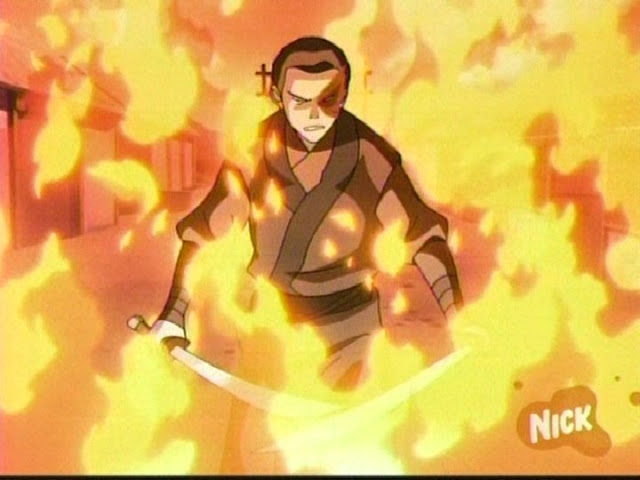

Zuko can be pretty scary when he wants to be.  


Interestingly, the other main villain of season 1 is the Fire Nation Commander Zhao, who serves as an excellent foil for Zuko.  Both he and Zuko are in a race to capture to the Avatar, but their morals are clearly quite different.  For example, in episode 3, Zuko challenges Zhao to a duel and beats him, fair and square, but chooses to spare Zhao's life.  Zhao responds by attacking Zuko as soon as the prince turns his back.  Uncle Iroh intervenes, subdues Zhao, and then calmly walks away, leaving Zhao with the scathing observation that, "Even in exile, my nephew has more honor than you."

Although Zuko clearly has redeeming qualities from the very beginning, his transformation from evil to good is very slow.  Zuko is not a very wise person, even for his age; he's impetuous, highly emotional, and tends to see everything in black and white.  Above all, he's been so obsessed for so long with restoring his birth-right and winning his father's love that he finds it hard to look at the world through any other lens.  Zuko gets smacked in the face with hard life lessons over and over again, and his uncle's constant benign influence and good advice seem to mostly bounce off him with no effect.  This can be very frustrating to watch.  But, that being said, changing yourself is hard--and I love that the creators of Avatar took the time to show this in all its anti-glory.


When your most fundamental beliefs are being challenged by everything you see around you, you can't accept it so easily.  There is a cost to letting go of the ideas you were raised with.  You can't simply change sides, at the drop of a hat, in a war that you've always believed was just.  You can't simply abandon your family, whom you've always wanted to love and be loved by in return, even when their inherent evil is so obvious to everyone else.  We see Zuko, scarred and humiliated, pay the price for changing himself, his worldview, and his values.  He moves--three steps forward, two steps back--towards becoming "the beautiful prince" that he has the potential to be. 


One of the most brilliant master-strokes of the entire show is in season 3, when Zuko finally has everything he wanted: his father accepted him back, his honor is restored, and he's being hailed as a hero throughout the Fire Nation--but then he chooses to give it all up.  This  is the most difficult and the most intriguing part of Zuko's journey, because now the conflict is purely internal.  All external enemies and obstacles have been removed, everything he wanted is his, and yet he still feels this deep contradiction, this wrongness within himself.  He has nowhere else to turn, no one else at whom he can direct his rage; the only thing he can do to cure himself is turn inward and truly confront his own demons. 


And he does. 


That's what makes Zuko amazing.  Most people in that situation would bury themselves in pleasures and power, and drown out those nettling barbs of conscience with thoughts of self-righteousness, egoism, and desperate self-justification.  Not Zuko. 


He takes his final step to self-determination when he confronts his father in a scene that is both touching and powerful.  Zuko finally becomes his own person, free of the negative influences and lies that he was raised with.  And he got there precisely because of his relentless refusal to give up the things he held most dear.  He's an underdog who got to the top, and then had the strength to give it all up for something lonelier and riskier, something purer and infinitely more precious: a chance to destroy the influences that had so corrupted him, and replace them with something better.  He chose to risk everything to try and create a better world, rather than reign over the tortured remains of the world corrupted by his forefathers. 


Zuko's journey is profound, poignant, painful, and awe-inspiring: the prince who became a outcast, the outcast who became a false hero, the false hero who became a revolutionary.  His inner strength is unparalleled, not just because he refused to give up in the face of impossible odds, but because, at the moment of his greatest success, he had the courage to look his darkest self in the face and triumph over him.  For that, Bryan Konietzko and Michael Dante DiMartino, I applaud you!

Monday, April 28, 2014

Upcoming Referendum on Legislative Maps in Illinois - Nov. 4, 2014!

Remember that article I wrote a few months back, arguing for an end to gerrymandering in Illinois?  Well, turns out there's an organization called Yes for Independent Maps, and they've been collecting signatures to get the issue on the ballot at this November's election!  They needed to collect 300,000 signatures of registered Illinois voters in order to put their proposed amendment on the ballot--and they succeeded!  I managed to get on board just in time to get my own copy of their petition, and I collected signatures and sent them in just under the deadline.  On May 1st, they'll have a celebration breakfast in downtown Chicago, load the petitions on to a semi-truck, and drive them down to Springfield where they will officially submit them.  The state will then cross-check the signatures and addresses on the petitions.  If the total of legitimate signatures is over 300,000, then their will be a referendum on the amendment on Nov. 4, 2014.   The residents of Illinois can vote either yes or no.  

Some brief facts about the campaign:

The Illinois Independent Redistricting Amendment would establish independent commission to draw the electoral maps.   
This commission would consist of 11 non-politicians: four Democrats, four Republicans and three independents.
This amendment would effect redistricting for state legislators only, not federal legislators.  

To see a summary and complete draft of the amendment, click here.  


Other links of interest: 


CLTV Interview with campaign manager, Michael Kolenc.


Chicago Tribune Editorial: A fair legislative map means better Democratic candidates


Monday, March 24, 2014

Miyazaki's "The Wind Rises" - a story of genius fulfilled

SPOILER ALERT: In this post, I talk in great detail about The Wind Rises.  If you haven't seen it yet, you might want to skip this post and come back later.  :-)

~~~~~~~~~~
Miyazaki's latest and (allegedly) final movie doesn't have much of a plot.  There is no grand climax, and not even much character development.  It's just the story of a boy's life, as he follows his life's ambition to be an aeronautical engineer.  It takes place in Japan, from just a few years before the Great Kanto Earthquake of 1923, through Japan's ensuing economic collapse, and into World War II.  Although you witness all these disasters in the film, the main character, Jiro, seems oddly detached from them emotionally.  And though the moral question of how the planes that he's creating are being used does come up repeatedly, he never really grapples with the issue in any noticeable way.  Even surrounded by the wreckage of a war that he, in a material way, helped to create, he remains aloof, untouched--forever in his own little world.  

It is easy to describe The Wind Rises in this way, and if you do, it sounds terrible.  But with all this being said, I found this movie to be beautiful, touching, full of life, inspiration, and experiences both sensual and surreal.  I loved it.