An interesting article about the different gender expectations for and reactions to compliments.
http://www.theatlantic.com/health/archive/2013/12/why-men-cant-take-compliments/282164/
From my personal experience, I have found it to be true that it's more socially acceptable for a guy to give personal compliments to woman, rather than the other way around. If a woman compliments or shows too much interest in a guy, it's more likely to be mocked and perceived as the woman "throwing herself" at him. In general, I think women are expected to be more subtle when it comes to showing romantic interest in someone.
What are other people's experiences with this? Do you especially agree/disagree with anything the article said?
Wednesday, December 18, 2013

Sunday, December 15, 2013
What is education? (Effective vs. Ineffective Learning)
The Five Pillars of Modern Education
Everyone acknowledges that our modern system of education is riddled with problems: inequality, inflexibility, under-achievement, huge amounts of money and effort continuously resulting in sub-par test scores. Many different suggestions have been made and many fingers pointed at possible suspects: it's the teachers! it's the parents! it's the curriculum! it's the funding! lack of teacher training! lack of teacher accountability! it's our inherently racist/sexist/socialist/capitalist society, etc., etc. There may be truth in some of these ideas or accusations, but before we blindly embark on another sweeping(ly expensive and meddlesome) education reform, I'd just like to ask: what is education, anyway? And what is it really for?
There are many different education methodologies used all over the world. I have direct experience with those in the US (as a native student), France (exchange student), and Korea (teacher). Though all three places are markedly different, I would still say they have more in common that not. Specifically, schooling seems to focus on these things:
1) the memorization of a HUGE number of facts, more than anyone could ever possibly remember or put to use.
2) a linear progression through a curriculum that includes all core subjects all the time, which are none-the-less kept constantly separate and distinct from one another.
3) a rigid schedule and highly supervised series of classes, where all students must do essentially the same things at the same time.
4) the seeming necessity of spending a lot of time on homework, studying, or both.
5) an extremely high value put on the results of tests and quizzes, especially standardized tests, which are then used to determine a child's future opportunities.
Now, I understand that these five fundamental pillars of public education are in place for logical reasons. Some of it has to do with resource limitations, or the need to objectively measure progress and success. But what I find interesting is the underlying assumption in all schooling systems that children cannot be left to their own resources--that, if you allow them to budget their own time and do what they want, they will do nothing but waste their time. There is usually very little room for individualization and self-directed exploration in our schools.
You might say, "Well, of course! No child wants to study! If we didn't make them do it, then most of them never would." In a sense, that might be true, but I think that we often confuse studying with learning. Our schools are purportedly places where children learn--but let's be honest, how much do any of us remember, out of all the things we had to study in K-12? If you really think about all that stuff you had to memorize? I'm just going to go out on a limb for moment, and bet that most people remember less than 10% of everything they had to learn in K-12, no matter how smart they are. If we don't remember most of what we've learned, we can't really say that we've learned it at all, can we? I think that our education system needs to make sure that students learn, not more, but more effectively.
The Keys to Effective Learning
In order for learning to be effective, I think you need three things:
1) a student needs to remember what they learned,
2) be able to make meaningful connections between that knowledge and other things they know, and
3) be able to apply it in their own lives.
It serves no purpose whatsoever to memorize stuff for a test and then forget it the next day, or week, or month. Personally, I can say that this is mostly what I did in school, especially in subjects like math, science, and history, which require a high degree of memorization, and which I had little time or interest to explore outside the classroom.
However, I did retain a good deal of what I learned in French and English. Why? Part of it was simple interest. These were my favorite subjects. (Ironically, they were also the subjects in which my grades were the most inconsistent). But it was also because of how I learned the information in those subjects. I've always had a gift for making connections between words and finding patterns in language. I did this constantly in French and English. When studying vocab, I entertained myself by finding similarities between related words, and when I was outside of school, I often challenged myself to try and identify objects around me in French. Every time I happened across something written in French, I tried to figure out what it meant. For me, language is an exciting puzzle, a secret code to decipher. It's the closest thing on earth to having a super power: to understand conversations that other people around you cannot, to be able to read what can only be meaningless scribbles to the uninitiated. I won't lie, speaking a foreign language gives me a heady sense of power and privilege--of being privy to an entire secret world, a culture, millions of people who would otherwise be rendered inaccessible behind a language barrier.
I understand, of course, that most people do not feel this way about languages. They don't have the court intrigue/X-men super-hero fantasy at the back of their minds that makes language learning so exciting for me. What I learned from this though, is how to learn. As I said, it's not just the interest, nor is it just about having a "gift" that makes one adept at learning. Learning to see patterns and make connections is something that can be taught and applied to all subjects.
In other words, everyone can learn how to learn.
But it goes beyond that. Beyond the patterns and connections, you have to use what you have learned and integrate it into your life somehow. That's how I've retained my French over the years--I use it whenever I get the chance--and everything that I remember from English class is from the stories and essays that had a deeper meaning for me. There were always things in literature that I identified with, that I could appreciate in the context of my own life. That was real learning. I was learning about life.
Ironically, this is also what made English and French classes the most painful for me. There were valuable things that I could extract from reading Alexander Pope, Shakespeare, Walt Whitman, and Emily Dickinson--but I extracted these things mostly in spite of, and not because of, all the assignments and tests that came with them. When I read Hamlet, the teacher required us to write notes and "responses" to every single scene. And with the deadline looming, I found myself rushing through it, focused more on what the hell I could write that the teacher would find interesting, rather than having the leisure to dwell on what I found interesting. I could have been learning from it--but I wasn't. There wasn't time, and the more "important" thing was to come up with some bullshit response to give the teacher for the sake of my grades.
The Value of Self-Education
How is it, that we spend so much of our lives in school, and yet school leaves no time for real learning? I honestly think that real learning only happens when someone is ready for it, and when they have the freedom to go about it in their own way. Sure, there are good things to be said for having the guidance of a teacher, but mostly, I think it's so much more gratifying, exciting, and truly educational to discover things for yourself. It is the most meaningful and effective way to learn.
You might argue that this is nice in theory, but you can't possibly expect people to "discover" everything on their own. As I mentioned earlier, people all have different interests, and I myself was mostly interested in the artistic or language-related subjects in school. But let me tell you something interesting. When I finally finished my "education," (a.k.a. got out of college), something changed. I suddenly had the freedom to learn about whatever caught my fancy at the time. And I found that what caught my fancy first was history.
I had always liked history, and I had been developing a growing interest in politics, but it had never really been at the forefront of my academic endeavors. I had taken history classes, sure, but I never read a history book in its entirety until after I graduated from college. That book was Joseph Ellis's Founding Brothers. During my senior year, my high school government teacher had recommended it to the class. I always thought it sounded interesting, so much so that even 5 years later I still remembered it, but I never had the time or the energy to read it while I was in school.
I can safely say that I effectively learned more about the first 20 years of U.S. history (post-1776) from that book than I ever did in school. It's because I was genuinely interested in what I was reading, I didn't have a test or a paper looming in the back of my mind, no deadlines to rush me through it. I could take my time, think about it the way I wanted, dawdle over the more interesting parts, and make connections between that book and other things that I knew--not only about American history, but about leadership, the shaping of all history, how views of history change through the kaleidoscope of time, and the way our perception of history today sets the stage for everything we do. Joseph Ellis has a wonderful way of making history real. Here were no facts or figures to memorize--only people to meet and stories to tell. Fascinating people--Washington, Adams, Jefferson, Hamilton, Madison.... People I had studied numerous times before, and yet never really known as fellow human beings. This is what history is really about.
I will say it again, and again, and again: literature is about real life; history is about real life; science and math are about real life. All learning is about life, about understanding ourselves as human beings, about understanding the world around us.
Likewise, my post-college education wasn't limited to history. In the past, science had been a far cry from my favorite subject. I usually thought of it as merely tolerable. And yet recently, I've been getting interested in that too. Do you know how many great science videos there are on youtube? Smarter Every Day and SciSchow are my current favorites. And honestly, when I was a child, I was really interested in science. Maybe not biology, or chemistry, or physics, specifically--I was interested in dinosaurs! No, scratch that. I was obsessed with dinosaurs.
I have been told that it started at the age of 3 when my dad brought home a VHS copy of The Land Before Time. (So, really, it was all his fault :-P). From then until the age of 9 or 10, I read everything about dinosaurs that I could get my hands on. I watched every movie, psyched myself out over every trip to the museum to see fossils, and religiously attended the annual exhibition of robotic dinosaurs that appeared in the local mall every winter. Although dino-obsession may not be the most conventional way of learning science, I did learn a lot about biology, geology, and natural history during those years. I could name more dinos off the top of my head than there are States in the Union; I could tell you all about evolution, continental drift, the different extinction theories, about the Triassic, Jurassic, and Cretaceous periods and which dinosaurs lived in which period; how fossils were dug up, and how the different layers of rock told you about which era the fossils were from. I am pretty sure that my years of dino-mania laid the groundwork for me to do well in science class later on.
Now, you could argue that I am an exception. How many kids get that totally obsessed with something? Actually, I think most kids get really obsessed with things. It just depends on what and when. How many kids are avid readers like I was? Maybe not a lot, but whatever a child is interested in, whether it involves books or not, obviously it gives them some kind of mental and emotional stimulation. Obviously, it is doing something for their little, growing brains.
And what about adults? What about after all those years of schooling? How many people are going to start reading history books, listening to Great Courses' lectures from the library, or make a hobby out of reading the news, like I did? Or how many people do you know who simply get out of college, get a job, and spend most of the rest of their lives working, drinking, raising kids, and watching TV? Sadly, a lot of the latter, I think. But I also believe that it's because this is how people have been conditioned. In a weird way, this is what society expects. As Astra Taylor points out in her talk on "Unschooling," our current society needs most people to be drones: people who will work at mindless jobs, produce conveniences, accessories, data, and various other smorgasbord en masse, and ask no questions.
But people are naturally curious animals! As Michio Kaku says, "All children are born scientists." As children, we want to know everything! We're overflowing with creativity, and we're so full of a desire to learn, but by the time we finish umpteen years of schooling, that natural curiosity seems to be burned out in most people.
If you give people the time and freedom to explore, I think you'd be surprised at how many things they'd be interested in. And if they don't learn about everything--if they're not all perfect Renaissance men and women--who cares? It's not like our current system is producing Renaissance men and women, though if you looked at the curriculum you would certainly think that was the goal.
There is one more compelling example I must mention. There's a co-teacher that I had in Korea. His name is Yi Jae-ik, and I had the pleasure of working with him for one semester. He follows a teaching philosophy of giving no orders, no punishments, and no rewards. He believes in letting students learn in their own way, at their own pace. He believes in the teacher's responsibility to listen to the students--that their needs and wishes are never foolish, or selfish, or trivial. The most impressive thing that I saw, was that students who previously had given up on English--who knew almost nothing, who had no motivation and no interest--suddenly started to make an effort. He made English accessible to them, and allowed them to study things that were at their level (i.e. making their own vocab cards of any words they pleased, using Rosetta stone, allowing them to ask any questions they wanted), and encouraged them in all things. The kids might have been learning at a much slower pace than the actual curriculum, but they were learning deeply, effectively, in other words, TRULY learning English, some of them for the first time in their lives. They may never do well on a standardized test, but they will remember what they learned in Yi Jae-ik's class for a long, long time--that is something indeed.
Michio Kaku - All kids are born geniuses
Ken Robinson - How to escape education's death valley
Ken Robinson - How schools kill creativity
“Actually, all education is self-education. A teacher is only a guide, to point out the way, and no school, no matter how excellent, can give you education. What you receive is like the outlines in a child’s coloring book. You must fill in the colors yourself.”
~Louis L'Amour
"Everyone is born a genius. But if you judge a fish on its ability to climb a tree, it will live its life believing it is stupid."
~attributed to Albert Einstein (though I don't believe there's a reputable source for this--but it's a good quote anyways)
"I simply wasn't ready to read. And it was painful trying to learn. Painful. It was like trying to force a penny through a hole that's too small."
~My friend, Catherine, on her early years in school. She learned to read later--when she was ready. She is now one of the most avid readers and one of the most curious minds that I am blessed to know.
Yi Jae-ik, who showed me that children really do learn more when you give them freedom.
Everyone acknowledges that our modern system of education is riddled with problems: inequality, inflexibility, under-achievement, huge amounts of money and effort continuously resulting in sub-par test scores. Many different suggestions have been made and many fingers pointed at possible suspects: it's the teachers! it's the parents! it's the curriculum! it's the funding! lack of teacher training! lack of teacher accountability! it's our inherently racist/sexist/socialist/capitalist society, etc., etc. There may be truth in some of these ideas or accusations, but before we blindly embark on another sweeping(ly expensive and meddlesome) education reform, I'd just like to ask: what is education, anyway? And what is it really for?
There are many different education methodologies used all over the world. I have direct experience with those in the US (as a native student), France (exchange student), and Korea (teacher). Though all three places are markedly different, I would still say they have more in common that not. Specifically, schooling seems to focus on these things:
1) the memorization of a HUGE number of facts, more than anyone could ever possibly remember or put to use.
2) a linear progression through a curriculum that includes all core subjects all the time, which are none-the-less kept constantly separate and distinct from one another.
3) a rigid schedule and highly supervised series of classes, where all students must do essentially the same things at the same time.
4) the seeming necessity of spending a lot of time on homework, studying, or both.
5) an extremely high value put on the results of tests and quizzes, especially standardized tests, which are then used to determine a child's future opportunities.
Now, I understand that these five fundamental pillars of public education are in place for logical reasons. Some of it has to do with resource limitations, or the need to objectively measure progress and success. But what I find interesting is the underlying assumption in all schooling systems that children cannot be left to their own resources--that, if you allow them to budget their own time and do what they want, they will do nothing but waste their time. There is usually very little room for individualization and self-directed exploration in our schools.
You might say, "Well, of course! No child wants to study! If we didn't make them do it, then most of them never would." In a sense, that might be true, but I think that we often confuse studying with learning. Our schools are purportedly places where children learn--but let's be honest, how much do any of us remember, out of all the things we had to study in K-12? If you really think about all that stuff you had to memorize? I'm just going to go out on a limb for moment, and bet that most people remember less than 10% of everything they had to learn in K-12, no matter how smart they are. If we don't remember most of what we've learned, we can't really say that we've learned it at all, can we? I think that our education system needs to make sure that students learn, not more, but more effectively.
The Keys to Effective Learning
In order for learning to be effective, I think you need three things:
1) a student needs to remember what they learned,
2) be able to make meaningful connections between that knowledge and other things they know, and
3) be able to apply it in their own lives.
It serves no purpose whatsoever to memorize stuff for a test and then forget it the next day, or week, or month. Personally, I can say that this is mostly what I did in school, especially in subjects like math, science, and history, which require a high degree of memorization, and which I had little time or interest to explore outside the classroom.
However, I did retain a good deal of what I learned in French and English. Why? Part of it was simple interest. These were my favorite subjects. (Ironically, they were also the subjects in which my grades were the most inconsistent). But it was also because of how I learned the information in those subjects. I've always had a gift for making connections between words and finding patterns in language. I did this constantly in French and English. When studying vocab, I entertained myself by finding similarities between related words, and when I was outside of school, I often challenged myself to try and identify objects around me in French. Every time I happened across something written in French, I tried to figure out what it meant. For me, language is an exciting puzzle, a secret code to decipher. It's the closest thing on earth to having a super power: to understand conversations that other people around you cannot, to be able to read what can only be meaningless scribbles to the uninitiated. I won't lie, speaking a foreign language gives me a heady sense of power and privilege--of being privy to an entire secret world, a culture, millions of people who would otherwise be rendered inaccessible behind a language barrier.
I understand, of course, that most people do not feel this way about languages. They don't have the court intrigue/X-men super-hero fantasy at the back of their minds that makes language learning so exciting for me. What I learned from this though, is how to learn. As I said, it's not just the interest, nor is it just about having a "gift" that makes one adept at learning. Learning to see patterns and make connections is something that can be taught and applied to all subjects.
In other words, everyone can learn how to learn.
But it goes beyond that. Beyond the patterns and connections, you have to use what you have learned and integrate it into your life somehow. That's how I've retained my French over the years--I use it whenever I get the chance--and everything that I remember from English class is from the stories and essays that had a deeper meaning for me. There were always things in literature that I identified with, that I could appreciate in the context of my own life. That was real learning. I was learning about life.
Ironically, this is also what made English and French classes the most painful for me. There were valuable things that I could extract from reading Alexander Pope, Shakespeare, Walt Whitman, and Emily Dickinson--but I extracted these things mostly in spite of, and not because of, all the assignments and tests that came with them. When I read Hamlet, the teacher required us to write notes and "responses" to every single scene. And with the deadline looming, I found myself rushing through it, focused more on what the hell I could write that the teacher would find interesting, rather than having the leisure to dwell on what I found interesting. I could have been learning from it--but I wasn't. There wasn't time, and the more "important" thing was to come up with some bullshit response to give the teacher for the sake of my grades.
The Value of Self-Education
How is it, that we spend so much of our lives in school, and yet school leaves no time for real learning? I honestly think that real learning only happens when someone is ready for it, and when they have the freedom to go about it in their own way. Sure, there are good things to be said for having the guidance of a teacher, but mostly, I think it's so much more gratifying, exciting, and truly educational to discover things for yourself. It is the most meaningful and effective way to learn.
You might argue that this is nice in theory, but you can't possibly expect people to "discover" everything on their own. As I mentioned earlier, people all have different interests, and I myself was mostly interested in the artistic or language-related subjects in school. But let me tell you something interesting. When I finally finished my "education," (a.k.a. got out of college), something changed. I suddenly had the freedom to learn about whatever caught my fancy at the time. And I found that what caught my fancy first was history.
I had always liked history, and I had been developing a growing interest in politics, but it had never really been at the forefront of my academic endeavors. I had taken history classes, sure, but I never read a history book in its entirety until after I graduated from college. That book was Joseph Ellis's Founding Brothers. During my senior year, my high school government teacher had recommended it to the class. I always thought it sounded interesting, so much so that even 5 years later I still remembered it, but I never had the time or the energy to read it while I was in school.
I can safely say that I effectively learned more about the first 20 years of U.S. history (post-1776) from that book than I ever did in school. It's because I was genuinely interested in what I was reading, I didn't have a test or a paper looming in the back of my mind, no deadlines to rush me through it. I could take my time, think about it the way I wanted, dawdle over the more interesting parts, and make connections between that book and other things that I knew--not only about American history, but about leadership, the shaping of all history, how views of history change through the kaleidoscope of time, and the way our perception of history today sets the stage for everything we do. Joseph Ellis has a wonderful way of making history real. Here were no facts or figures to memorize--only people to meet and stories to tell. Fascinating people--Washington, Adams, Jefferson, Hamilton, Madison.... People I had studied numerous times before, and yet never really known as fellow human beings. This is what history is really about.
I will say it again, and again, and again: literature is about real life; history is about real life; science and math are about real life. All learning is about life, about understanding ourselves as human beings, about understanding the world around us.
Likewise, my post-college education wasn't limited to history. In the past, science had been a far cry from my favorite subject. I usually thought of it as merely tolerable. And yet recently, I've been getting interested in that too. Do you know how many great science videos there are on youtube? Smarter Every Day and SciSchow are my current favorites. And honestly, when I was a child, I was really interested in science. Maybe not biology, or chemistry, or physics, specifically--I was interested in dinosaurs! No, scratch that. I was obsessed with dinosaurs.
I have been told that it started at the age of 3 when my dad brought home a VHS copy of The Land Before Time. (So, really, it was all his fault :-P). From then until the age of 9 or 10, I read everything about dinosaurs that I could get my hands on. I watched every movie, psyched myself out over every trip to the museum to see fossils, and religiously attended the annual exhibition of robotic dinosaurs that appeared in the local mall every winter. Although dino-obsession may not be the most conventional way of learning science, I did learn a lot about biology, geology, and natural history during those years. I could name more dinos off the top of my head than there are States in the Union; I could tell you all about evolution, continental drift, the different extinction theories, about the Triassic, Jurassic, and Cretaceous periods and which dinosaurs lived in which period; how fossils were dug up, and how the different layers of rock told you about which era the fossils were from. I am pretty sure that my years of dino-mania laid the groundwork for me to do well in science class later on.
Now, you could argue that I am an exception. How many kids get that totally obsessed with something? Actually, I think most kids get really obsessed with things. It just depends on what and when. How many kids are avid readers like I was? Maybe not a lot, but whatever a child is interested in, whether it involves books or not, obviously it gives them some kind of mental and emotional stimulation. Obviously, it is doing something for their little, growing brains.
And what about adults? What about after all those years of schooling? How many people are going to start reading history books, listening to Great Courses' lectures from the library, or make a hobby out of reading the news, like I did? Or how many people do you know who simply get out of college, get a job, and spend most of the rest of their lives working, drinking, raising kids, and watching TV? Sadly, a lot of the latter, I think. But I also believe that it's because this is how people have been conditioned. In a weird way, this is what society expects. As Astra Taylor points out in her talk on "Unschooling," our current society needs most people to be drones: people who will work at mindless jobs, produce conveniences, accessories, data, and various other smorgasbord en masse, and ask no questions.
But people are naturally curious animals! As Michio Kaku says, "All children are born scientists." As children, we want to know everything! We're overflowing with creativity, and we're so full of a desire to learn, but by the time we finish umpteen years of schooling, that natural curiosity seems to be burned out in most people.
If you give people the time and freedom to explore, I think you'd be surprised at how many things they'd be interested in. And if they don't learn about everything--if they're not all perfect Renaissance men and women--who cares? It's not like our current system is producing Renaissance men and women, though if you looked at the curriculum you would certainly think that was the goal.
There is one more compelling example I must mention. There's a co-teacher that I had in Korea. His name is Yi Jae-ik, and I had the pleasure of working with him for one semester. He follows a teaching philosophy of giving no orders, no punishments, and no rewards. He believes in letting students learn in their own way, at their own pace. He believes in the teacher's responsibility to listen to the students--that their needs and wishes are never foolish, or selfish, or trivial. The most impressive thing that I saw, was that students who previously had given up on English--who knew almost nothing, who had no motivation and no interest--suddenly started to make an effort. He made English accessible to them, and allowed them to study things that were at their level (i.e. making their own vocab cards of any words they pleased, using Rosetta stone, allowing them to ask any questions they wanted), and encouraged them in all things. The kids might have been learning at a much slower pace than the actual curriculum, but they were learning deeply, effectively, in other words, TRULY learning English, some of them for the first time in their lives. They may never do well on a standardized test, but they will remember what they learned in Yi Jae-ik's class for a long, long time--that is something indeed.
Sources of inspiration for this post:
Astra Taylor on "Unschooling" - an extremely interesting approach to education (skip the first 2 minutes; the talk itself only lasts until about minute 47--after that it's a discussion with the audience)
Astra Taylor on "Unschooling" - an extremely interesting approach to education (skip the first 2 minutes; the talk itself only lasts until about minute 47--after that it's a discussion with the audience)
Michio Kaku - All kids are born geniuses
Ken Robinson - How to escape education's death valley
Ken Robinson - How schools kill creativity
“Actually, all education is self-education. A teacher is only a guide, to point out the way, and no school, no matter how excellent, can give you education. What you receive is like the outlines in a child’s coloring book. You must fill in the colors yourself.”
~Louis L'Amour
"Everyone is born a genius. But if you judge a fish on its ability to climb a tree, it will live its life believing it is stupid."
~attributed to Albert Einstein (though I don't believe there's a reputable source for this--but it's a good quote anyways)
"I simply wasn't ready to read. And it was painful trying to learn. Painful. It was like trying to force a penny through a hole that's too small."
~My friend, Catherine, on her early years in school. She learned to read later--when she was ready. She is now one of the most avid readers and one of the most curious minds that I am blessed to know.
Yi Jae-ik, who showed me that children really do learn more when you give them freedom.
Thursday, December 5, 2013
Two Visions of van Gogh
I recently watched two documentaries about Vincent van Gogh: one, simply called Vincent, came out in 1987, directed by Paul Cox and narrated by John Hurt. The other is called Van Gogh: Painted with Words (2010),
directed by Andrew Hutton and starring Benedict Cumberbatch as
Vincent. Both of them are comprised entirely of words taken directly
from period sources, principally from van Gogh's letters to his brother
Theo. Yet, they're strikingly different takes on the same man and the
same events.
The Paul Cox film is powerful in great part because of its pure simplicity and cohesion. It consists entirely of a narration of van Gogh's letters to Theo, voiced by John Hurt, while the camera moves over scenes of the places, buildings, and countryside like those that van Gogh frequented and painted. The few actors that actually appear in the film are not heard at all--they move silently across the screen, almost ghost-like. You have the sense of being in van Gogh's head, of hanging suspended amid those images as you listen to his thoughts as he expressed them to his beloved brother.
The Andrew Hutton film, on the other hand, is slightly unnerving from the very beginning as it seems to mirror the schizophrenia that tormented van Gogh. Contrary to the meditative quality of the Cox film, this one jumps rapidly from shot to shot, from disconcerting close-ups of van Gogh's face to views of his cell in the asylum, to other images or lines that you don't fully grasp at first. It also goes back and forth between Alan Yentob in the present, narrating and explaining, and Cumberbatch and the other actors portraying van Gogh in his own time. Personally, I found this style to be more jarring and less effective--at first. But as I went along, I got that sense that what the director wanted to capture was not just the emotional and spiritual weight of van Gogh's words, but also the frenetic energy that dominated his character. This movie is less of a cerebral-emotional experience and more of a visceral-emotional experience. You definitely get a more powerful sense of his madness in this one--a more accurate picture of how he appeared to others and why he had such hard time with relationships, and life in general.
This is also reflected in Cumberbatch's performance vs. John Hurt's. Hurt's version was more of...well, a narration. It was a little more even-keel, though that is not to say that he expressed less feeling! The emotional impact of Hurt's performance was very powerful--just less effusive. Cumberbatch's interpretation was much more volatile, moving abruptly between manic intensity and quiet, profound depression. Hurt conveyed more melancholy while Cumberbatch conveyed the sense of a man striving desperately to make a place for himself in the world and leave something behind that was worthwhile.
I think both interpretations are beautiful, and these two documentaries complement each other well. I might still prefer the style of Cox's film; it seems much smoother and more crafted, while certain scenes and transitions in the Hutton film irked me a bit, but Hutton's movie also has a gritty quality to it that I appreciate.
On the other hand, perhaps the Cox film, by showing only the inner life of van Gogh and framing it with a reverence bordering on idealism, is the less realistic, or maybe less complete, portrayal of the two. But they're both true--whether you want to lose yourself in the inner world of van Gogh's mind or witness all the inconsistent, nervous energy of a very flawed but brilliant man struggling to make his way among others, both of these homages to Vincent van Gogh are well worth your while.
The Paul Cox film is powerful in great part because of its pure simplicity and cohesion. It consists entirely of a narration of van Gogh's letters to Theo, voiced by John Hurt, while the camera moves over scenes of the places, buildings, and countryside like those that van Gogh frequented and painted. The few actors that actually appear in the film are not heard at all--they move silently across the screen, almost ghost-like. You have the sense of being in van Gogh's head, of hanging suspended amid those images as you listen to his thoughts as he expressed them to his beloved brother.
The Andrew Hutton film, on the other hand, is slightly unnerving from the very beginning as it seems to mirror the schizophrenia that tormented van Gogh. Contrary to the meditative quality of the Cox film, this one jumps rapidly from shot to shot, from disconcerting close-ups of van Gogh's face to views of his cell in the asylum, to other images or lines that you don't fully grasp at first. It also goes back and forth between Alan Yentob in the present, narrating and explaining, and Cumberbatch and the other actors portraying van Gogh in his own time. Personally, I found this style to be more jarring and less effective--at first. But as I went along, I got that sense that what the director wanted to capture was not just the emotional and spiritual weight of van Gogh's words, but also the frenetic energy that dominated his character. This movie is less of a cerebral-emotional experience and more of a visceral-emotional experience. You definitely get a more powerful sense of his madness in this one--a more accurate picture of how he appeared to others and why he had such hard time with relationships, and life in general.
This is also reflected in Cumberbatch's performance vs. John Hurt's. Hurt's version was more of...well, a narration. It was a little more even-keel, though that is not to say that he expressed less feeling! The emotional impact of Hurt's performance was very powerful--just less effusive. Cumberbatch's interpretation was much more volatile, moving abruptly between manic intensity and quiet, profound depression. Hurt conveyed more melancholy while Cumberbatch conveyed the sense of a man striving desperately to make a place for himself in the world and leave something behind that was worthwhile.
I think both interpretations are beautiful, and these two documentaries complement each other well. I might still prefer the style of Cox's film; it seems much smoother and more crafted, while certain scenes and transitions in the Hutton film irked me a bit, but Hutton's movie also has a gritty quality to it that I appreciate.
On the other hand, perhaps the Cox film, by showing only the inner life of van Gogh and framing it with a reverence bordering on idealism, is the less realistic, or maybe less complete, portrayal of the two. But they're both true--whether you want to lose yourself in the inner world of van Gogh's mind or witness all the inconsistent, nervous energy of a very flawed but brilliant man struggling to make his way among others, both of these homages to Vincent van Gogh are well worth your while.
Monday, November 18, 2013
The Nerd Generation
Our generation has been called a number of things: Millennials, Generation Y, the "Me" Generation. But honestly, none of those terms really capture who we are as a generation, do they? If the Millennials could be personified as a individual and contrasted with previous generations, who would that person be?
In my opinion: a nerd.
Being a nerd has never been SO cool. Almost all the big blockbuster movies these days are comic book adaptations, sci-fi, and fantasy. Who can count the number of Marvel and DC comic book movies that have come out in the past few years? They've revived the Star Trek and Star Wars franchises (with huge financial success), and Peter Jackson took The Lord of the Rings and turned it from a rather esoteric, cult-hit series of fantasy books, and made them into some of the highest-grossing, most epic films of all time. Not to mention Harry Potter, the Hunger Games, the Matrix, Avatar, The Hobbit, Ender's Game and most of the Pixar/Dreamworks movies. Even mainstream, teen romances are moving more and more into the sci-fi/fantasy realm. Twilight, anyone? I think most of Twilight's fan-base would not consider themselves to be nerds, and yet they worship characters and a story that exist in what would normally be considered a nerd/geek universe. It combines things geeks love (vampires, super-powers) with things that teenage girls love (romance and sparkles!). The other day my friend saw a section in the Barnes and Noble labeled "Paranormal Teen Romance." Things are definitely changing.
Also, need I mention that it was my generation that made anime popular in the West? What young person these days doesn't at least know the name Miyazaki? Over the course of my lifetime, I have seen the birth of the Anime & Manga section in bookstores--not only that, but literally every time I go back to Barnes & Noble I swear that section gets bigger. My generation grew up watching Transformers and Power Rangers, and when we got older we were delighted to discover a wealth of awesome anime-mecha series to geek out over, in addition to all those adorably kooky, bizarre anime romances, and intense, surreal dramas, thrillers, and horror flicks.


East to West - Japan's influence on the Nerd Generation
(clockwise from top left: The Power Rangers, Evangelion, Pacific Rim)
To catch up with this frenzy of nerdom, conventions and groups have been springing up all over the country where people who love these things can meet, mingle, and just generally geek out. Comic-Con is one of the most famous, with annual conventions popping up in cities all over the US, and in other countries as well. San Diego was the first city to kick off its annual Comic-Con in 1970, followed by Chicago in 1976--but the Comic-Cons really took off during our youth when Pittsburgh, Detroit (1994), New York (1996) and ten other cities (in the 2000's) started their own annual Comic-Cons. The biggest anime conventions in the US are Anime Expo (first held in 1992), Otakon (1994), Anime Central (1998), and many more have proliferated since then. The nerd wave may have really started with Generation X, but Generation Y has carried it on with gusto and made it their own.
 |
| New York Comic Con |
Of course, the people who go to conventions and immerse themselves in this stuff are still a small minority of the population.
Saturday, November 16, 2013
Yearnings
The cure for pain is in the pain.
Good and bad are mixed. If you don't have both,
you don't belong with us. - See more at: http://allspirit.co.uk/rumilovers.html#sthash.DLUmUn3q.dpuf
Good and bad are mixed. If you don't have both,
you don't belong with us. - See more at: http://allspirit.co.uk/rumilovers.html#sthash.DLUmUn3q.dpuf
The cure for pain is in the pain.
Good and bad are mixed. If you don't have both,
you don't belong with us. - See more at: http://allspirit.co.uk/rumilovers.html#sthash.DLUmUn3q.dpuf
Good and bad are mixed. If you don't have both,
you don't belong with us. - See more at: http://allspirit.co.uk/rumilovers.html#sthash.DLUmUn3q.dpuf
The cure for pain is in the pain.
Good and bad are mixed. If you don't have both,
you don't belong with us. - See more at: http://allspirit.co.uk/rumilovers.html#sthash.DLUmUn3q.dpuf
Good and bad are mixed. If you don't have both,
you don't belong with us. - See more at: http://allspirit.co.uk/rumilovers.html#sthash.DLUmUn3q.dpuf
The cure for pain is in the pain.
Good and bad are mixed. If you don't have both,
you don't belong with us. - See more at: http://allspirit.co.uk/rumilovers.html#sthash.DLUmUn3q.dpuf
Good and bad are mixed. If you don't have both,
you don't belong with us. - See more at: http://allspirit.co.uk/rumilovers.html#sthash.DLUmUn3q.dpuf
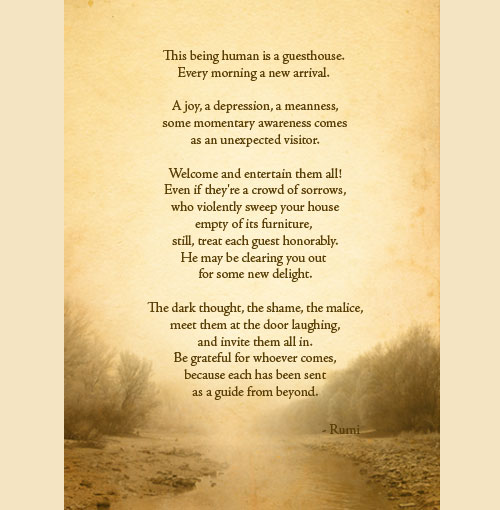
I think people in general have a tendency to overlook their own emotions. Either you dislike what you're feeling, so you try to distance yourself from it; or you feel too busy to deal with it; or you can't make sense out of it, so you try to tell yourself, "There's no reason for me to feel that way." But I disagree. There is always a reason for every feeling, even if that reason is subconscious. However, whether or not you understand the origin or reason behind every feeling doesn't entirely matter. One of the fundamentals of Rumi's philosophy is that all human emotion serves a purpose. Feelings are neither arbitrary nor meaningless. Every yearning, every desire you have exists so that you will seek out the things you really need--not only to live, but also to be a complete human being. We feel hunger so that we will eat. We feel tired so that we will sleep. We yearn to be creative and express ourselves because we need to create things. We yearn for God, for a higher spiritual order, because we need to make spiritual sense of our universe. It is not enough to just exist. We must know why. We must feel there is a purpose to our being.
I'm not saying that simply wanting there to be a God is a justification for believing in God. I think Rumi's idea is that, if there is a yearning, there must be an answer to that yearning. If we are thirsty, we must drink. No one would deny this. But does it not logically follow then, that if someone deeply longs to make music, they must make music? Why is it that so many famous artists throughout history have been destitute, starving, cast out of society, and yet somehow felt overwhelmingly compelled, not to seek out a decent paying job, but rather to make art? As Vincent van Gogh said in a letter to his brother, "Sometimes I draw . . . almost against my will, but it is a hard and difficult struggle to draw well." Why on earth would he choose to spend his time doing such a seemingly fruitless activity, when he lived in extreme poverty and only sold one painting in his entire lifetime? Because he had a hunger that needed to be fed: a hunger as real and demanding to him as any physical hunger.
This is where it gets difficult, I think. Everyone understands hunger, thirst, and tiredness because we all feel it in essentially the same way. But not everyone feels the need to draw, or play sports, or commune with God. Some people feel these yearnings so powerfully that it drives their entire lives, while others might feel that same yearning not at all. Still more people might feel a moderate amount of this or that desire, but not to the point where they would make such sacrifices as van Gogh did. When it comes to non-physical needs, it takes a great deal of empathy and patience to understand what drives people to do what they do. However, like Rumi, I believe that nothing we feel is without significance. Although making music, writing a story, or playing a sport might not be essential to life in the physical sense, it is essential in the spiritual sense. It is not water for our bodies, but for our souls. Whatever you do that makes you feel most truly happy and whole, that is your purpose in life. The trick is that it's up to you to find the right balance of these things in your life, and to be strong enough to insist on the things you need, even if other people don't understand them.
Of course, then you must ask, what if you yearn to do something wrong? What if the fruition of your desire would be harmful to other people, or even to yourself? Obviously you can't just use the excuse that you wanted to do it, so therefore it must be right. Our feelings and our desires need to be interpreted, balanced, and acted upon in a constructive way. An emotion may be leading you towards the right place, but you must interpret it correctly and find the right way to get there. Not all pathways to an objective are equal. For example, if you feel that a situation in your life is getting alarmingly out of control, perhaps your first impulse would be take control of it through violence or intimidation. That impulse is not the feeling you should follow. What you really need to ask yourself is, what is upsetting to me about this situation and how can I fix it in the most effective, benevolent way possible? Violence just leads to more violence, and running away from the situation just leaves it to be solved another day. But if it's upsetting to you, that means it needs to change, and there is probably a decent way to fix if you just think about it. I'm not saying that making that change is always easy, or that you can always do it without upsetting anybody, but most of the time, there is probably a constructive path that will lead you to what you really need.
Life hurts sometimes, but that pain only exists to tell us what we need. Rumi said, "The cure for pain is in the pain." It is a guide sent to lead you towards goodness and happiness. Even if you are lonely or feel unfulfilled, don't run away from that feeling. Don't ignore it. Follow it.
"That hurt we embrace becomes joy. Call it to your arms where it can change."
We can only change when we recognize our problems and decide to face them. If you feel broken, lost, empty, don't drown yourself in obligations and distractions. Follow your grief to the place where you can be whole.
The cure for pain is in the pain.
Good and bad are mixed. If you don't have both,
you don't belong with us. - See more at: http://allspirit.co.uk/rumilovers.html#sthash.DLUmUn3q.dpuf
Good and bad are mixed. If you don't have both,
you don't belong with us. - See more at: http://allspirit.co.uk/rumilovers.html#sthash.DLUmUn3q.dpuf
~~~~~~~~~~~
One night a man was crying,
Allah! Allah!
His lips grew sweet with the praising,
until a cynic said,
"So! I have heard you
calling out, but have you ever
gotten any response?"
The man had no answer to that.
He quit praying and fell into a confused sleep.
He dreamed he saw Khidr, the guide of souls,
in a thick, green foliage.
"Why did you stop praising?"
"Because I've never heard anything back."
"This longing
you express is the return message."
The grief you cry out from
draws you toward union.
Your pure sadness
that wants help
is the secret cup.
Listen to the moan of a dog for its master.
That whining is the connection.
There are love dogs
no one knows the names of.
Give your life
to be one of them.~Rumi

The Illuminated Rumi, translated by Coleman Barks

Subscribe to:
Posts (Atom)